My dad is one of eleven kids, and my mom is one of ten kids. Even though my aunts and uncles weren't nearly so prolific as my grandparents, I still have a whole lotta cousins, and it's great! Two cousins have had babies in the past month or so, and I'm blessed to live close enough to go visit.
Both are doing SO WELL, and both are nursing their little ones, which makes my heart sing. (and my milk ducts ache for another baby!) Since we're still waiting and praying for another blessing to our family, this is a lovely, lovely way to pass the time. :>)
So, let's keep the happy glow going with some fun links.
MAKE
Soap slivers. Growing up and pre-Hubs, I didn't have a soap sliver problem because we just grafted them together so the old soap melted into the new and got used up. That doesn't work for Hubs. So perhaps I'll dust off the crochet hook and make something like this Soap Saver from Crochet Spot.
I don't make much in the way of clothes for Goose, but I am nuts for this "In The Garden" Shirred Twirly Dress at From an Igloo.
So I made a crib sheet out of Care Bear fabric for Goose's toddler bed. It totally didn't lure her in to sleeping there (though we took down the crib and she's hanging in there). Short story is, I'd rather have elastic all the way around for a better fit, and look! Here's a Crib/Toddler Bed Sheet Tutorial by Dana from MADE (who I love to link up!) over at luvinthemommyhood.
Such a sweet idea - Fabric "Tea Bag" Sachet from Mademoiselle Chaos.
The Train To Crazy (hee!) made three versions of fabulously, wonderfully adorable duckling costumes. Goose may have to be a duckling for Halloween next year!!
I can hardly function without my keyboard wrist pad and wrist rest mouse pad, so I was very interested in this tutorial at Updates from the Copper State for a DIY Keyboard Wrist Rest.
EAT
After writing my enormous post on food additives, I love finding recipes like this one for homemade pizza rolls from Little Life Improvements - bonus: they freeze well!
Ooh, ooh, ooh! I found lots of good ideas "the most important meal of the day" including 10 Healthy Breakfast Ideas from Kelly The Kitchen Kop (and she'll tell you why we shouldn't eat breakfast cereal, Blueberry Streusel Muffins from Amy's Finer Things, Baked Soaked Oatmeal also from Kelly (I'll have to see how it stacks up to my soaked baked oatmeal), Homemade Breakfast Cereal from Kelly, Cheeseslave's Homemade Granola with Soaked Oats & Sprouted Flour, Homemade Grape Nuts from Encouraging Nourishment, and all these posts reminded me of Sarah's Grain Free Granola, now at heartland Renaissance.
The following recipe actually made me buy apples at the store even though I couldn't remember why! I'm thinking tomorrow, Goose and I will make some Whole Wheat Apple Cinnamon Cranberry Scones from heartland Renaissance. (Hey, Sarah... Sarah's Musings was a lot easier to spell! :>))
I am seriously hungry just looking at the picture of these Chicken Chimichangas from The Mother Huddle. (Yes, that growling you just heard was my stomach. Sorry.)
Add a big pile of cheese and some of this Homemade Enchilada Sauce from Lynn's Kitchen Adventures, and I might sign over my firstborn...
Admittedly, I'm just starting to wrap my head around using more sesame seeds. Which are a component of tahini paste. Which is a component of hummus, which is a healthy snack! Hallee the Homemaker tells us how to Swap Sunflower Seeds to Make Tahini.
DO
Some good ideas at 5 Tips for Surviving Summer Road Trips at Inspired to Action. From the comments section, I clicked through to a book on "Carschooling".
Here are 10 Organic Garden Aids from Tipnut.
Sounds like fun to me - Mad Scientist Party (well, the first five experiments thereof, anyway) at One Charming Party.
Admittedly, I'm more of a "buy stock cabinets" sort of girl, but I'm really impressed by this Playroom Storage Wall at Sawdust and Paper Scraps.
Happy clicking!
Saturday, May 15, 2010


Tuesday, May 11, 2010
Spring Cleaning Carnival - Get the Pesticides Out?

After writing last week's post on how Our Nebraska Feedlot and Farm is a Concentrated Animal Feeding Operation (CAFO), I wanted to do something similar on how we use pesticides on our farm and in our garden.
Check out what Laura from Heavenly Homemakers has to say about Organic Gardening over at Kitchen Stewardship (also check out the giveaway being held there!) as well as her follow up post with a bit more information on how she does it at Heavenly Homemakers.
Unfortunately my quest to "do something similar" was somewhat derailed by busy farmers who are a bit cranky that it's rained lately and we aren't done planting yet. But I spoke with another of Hubs's cousins, Joel, who farms and holds a degree from the university in... something related to ag (I forgot to ask and hate to bother him again) as well as my own dad, who brings qualifications including working in the agriculture industry in various capacities most of his life and growing one heck of a garden.
Crops
There are a number of different types of chemicals that can be applied to crops, and they include insecticides, which target insects; fungicides, which target fungi; and herbicides, which target weeds and other plant-type things that grow where you don't want them. Pesticides and insecticides can overlap somewhat, from what I understand, but pesticides also include control for animals such as ground squirrels, etc.
There are different methods of applying pesticides; and the two main ones are aerial application (using a spray plane) and ground application, which involves using a tractor and a sprayer or a planter, or applying through a center pivot system (that also is used to deliver water to the crop). The method of application is determined by cost, time constraints, the size and stage of the crop, and terrain.
When applying chemicals, there are many guidelines that must be followed for safe application. For example, it is illegal to apply chemicals within a certain distance of surface water. The chemicals break down in the soil, so they don't reach the ground water supply. In the case of using a pivot to apply chemicals, the pivot must have a back flow shutoff valve (that isn't the phrase Joel used, but it's the same thing) to prevent the chemicals from backing up into the well and reaching the water supply. The pivots are inspected for this.
Joel said the same thing as what his cousin Chris said last week in my post on our feedlot, that genetic modification has allowed ag producers to use far less pesticides, and not only that but the ones we do use are far less toxic than the ones that were used years ago. Several months ago, I had an interesting facebook conversation with Joel's brother regarding genetic modification. He is a biology professor at a college in addition to being a veterinarian. Perhaps someday I'll pull his comments together for a post, but I'll have to check with him first! Here's what Joel's brother said about GM:
Genetic modification occurs when a gene, a region of DNA that "codes" for a protein, is inserted into the genome of an organism (like corn). That gene, when expressed by the organism, produces a protein. Every protein produced by an organism is coded by a gene, or a region of DNA. So, for example, in the case of Bt corn. A gene from a bacteria (Bacillus thermophilus) is inserted into a corn seed's genome. In the corn plant, the gene is expressed with the other protein genes that make up the leaf and stalk structure. This protein is not digestible to corn borer beetle, so they don't colonize the plant. Ta-da, you have a corn-borer "resistant" corn plant.
The same thing is done with lots of crops, including many fruits and vegetables to make them ship without bruising, etc.
When you eat the corn, the DNA in the corn's genome is broken down into its constituent chemicals. Similarly, when you consume the corn, the protein produced by the corn's genes is broken down by enzymes in your GI tract (from your stomach and pancreas) that break every protein into its subunits, amino acids. You do not ever absorb "DNA" or "proteins", rather you absorb the chemical constituents that make them up. It is physically impossible to absorb a whole "protein" or a gene into your body.
Thus, genetically modified crops cannot, biologically speaking, pose a threat to any vertebrate that consumes them. All of the proteins you consume, whether plant or animal, "natural" or genetically modified, are broken down into tiny subunit before
absorbed by your body. An amino acid is an amino acid.
There simply exists no mechanism for you incorporate genetically modified genes or proteins into your body through your digestive tract. Proof exists in this manner--literally millions of hogs, chickens, and cattle consume millions of bushels of GMO grains over many years...over a decade now, and no adverse effects have been noted. This supports the conclusion that no "unknown" mechanism is in existence.
Whew.
Keep in mind that pesticides cost money, and higher input costs for producers means lower profits. Organic producers are typically not able to produce as much as those who use conventional methods, and therefore charge a higher price.
Gardens
My dad feels that pesticides on fruits and vegetables is probably overused. So, if you feel it is important to buy organic, that may not be a bad idea. (I should note that he didn't say that - that's how I feel.) We don't buy organic, but we do grow as much of our own food in our garden as possible, and I'm hoping that we can continue to expand what we grow.
The pesticides sold for home garden use are far less potent than the ones that we use on our crops. They have a shorter half-life, and break down relatively quickly in sunlight and water. There are a number of more "organic" methods of controlling pests. Two that I've bookmarked (but admittedly not perused) are Organic Gardening and VanMeer.com's Organic Foods and Gardening.
My dad felt that pesticides are overused far more with lawn application than gardening application, so next time the local company wants to apply stuff to your lawn, check it out and see what you really need first!
The Bottom Line
Laura wrote this on her post at Kitchen Stewardship: "When pesticides are sprayed over a field to kill critters, they have to land somewhere. They absorb right into the soil. Then, nutrients and “stuff” from the soil grow up into the plant and into the food growing there. Therefore, pesticides from the soil grow right up into the food. INTO the food."
Joel, my dad, and I are all decidedly not scientists. As much as I love Laura (and I really, truly do!), none of us agreed with this statement. We all feel that the chemicals applied to the plant are broken down and while they may be absorbed into the plant and therefore the food we consume, it is much different from eating an unwashed apple that has just been sprayed with something.
Last year, my dad brought me a bucket of apples that were more or less organic, and I turned them into applesauce. I remember being very nearly in tears after standing for HOURS, trying to cut out bad spots and worms that were still in the apples, to say nothing of the trails they left behind. Although I don't like to think about it, a worm or twelve probably wouldn't hurt my applesauce. I am not all that sure about worm poop, though. (And there were a LOT more than twelve worms involved...)
On a wider scale, the technological advances that have been made regarding controversial topics such as pesticides and genetic modification have led to a MUCH more stable food supply. Although I can't recall which "Little House" book by Laura Ingalls Wilder told the story of the grasshoppers, I still have a vivid picture in my mind of bugs as far as the eye could see, and they left *nothing* behind. I've read that this year could be a bad one for grasshoppers and I'm not kidding when I say that I'm worried about it.
We have insurance on our crops, but it wouldn't get near the level of a normal year for us (probably around half to two-thirds of the income we might usually expect). Not only would that be personally difficult for us, but a problem that widespread would also seriously affect the food supply and drive up prices.
So. What's a girl to do? I plant my own garden, with the help of my sweet Hubs. We use manure from a local sheep farmer as well as from our chickens. We use a small amount of pesticides when necessary, only as much as needed. It's all a balance between what you feel is right for YOUR family.
Next week's Spring Cleaning Carnival will cover clutter, and the week after that will close out the carnival with debt. You can see all the Spring Cleaning topics here.
Sunday, May 9, 2010
Daybook for May 9, 2010
Outside my window... dark, cool, and windy. It was like 80 degrees for an entire week, so I washed Goose's winter coat and hat and mittens intending to put them away. Looks like that was a mistake.
I am thinking... that I ought to go to bed early tonight for once. [Edit - I didn't make it, but I had a lovely visit with my sister-in-law :>))
I am thankful for... my cousin, who is spending mother's day as a mother of two. She birthed her second baby on Friday (ahem) out the "normal" exit after her first daughter was born via c-section. She really showed us how it's done, and I can't WAIT to go see them!
From the learning rooms... Goose has been really exploding with her imagination. I love hearing her play, and she does quite well playing by herself!
From the kitchen... my MIL made steak for dinner, and we got pizza for supper plus fixings to make "blizzards". I managed to fill up on pizza, so I'll have my blizzard tomorrow, I think. And I just realized I have zero plans for meals the rest of the week. Yikes.
I am wearing... PJs. A Minnesota Twins shirt and fleece pants with kitties on them.
I am creating... a few baby gifts - I love stitching for new little ones! I also made a Care Bears sheet for Goose, and she still won't sleep in her toddler bed. I used the scraps from that to make two simple Care Bears bags for Goose and my cousin's first daughter. And hair clippies - I re-did the shamrock I mangled for Goose's birthday, and I made a heart one for my cousin's little girl.
I am pondering... what a blessing it is to be forgiven.
I am reading... still the same things, also I will be adding to the list Kimberly Hahn's 'Graced and Gifted: Biblical Wisdom for the Homemaker's Heart' or so I'm told by Paperback Swap.
I am hoping... hmm, I guess things are pretty settled down, so I'm back to just my basic intercessions. God has given so many blessings lately to me and the ones I love!
I am hearing... Hubs, his parents, and sister are watching Avatar. I was tending to Goose for a big chunk of the beginning, so opted not to try and figure out what I'd missed.
Around the house... I actually cleaned it up pretty well this week! And last week, I gave Bar Keepers Friend a try on my awful shower floor and I'm thrilled to say it worked like a charm. Now to keep the house looking nice, well, that's a different story.
One of my favorite things... feeding the barn cats with my sister-in-law. Which was punctuated by a surprise visit from Hubs and our miniature donkey, who doesn't really like cats.
A few plans for the rest of the week... Bible study (only a few sessions left!), chiropractor appointment, hopefully a trip to see my cousin and her new baby, Mass on Wednesday or Thursday.
 A picture thought I am sharing... While Goose was eating breakfast one morning, I put her Easter bucket full of empty plastic Easter eggs in the spare bedroom. She heard me do it, but didn't see it. After she was out of her highchair, I went downstairs to get dressed. Usually she follows me down, but that day, she didn't.
When I came back upstairs, she was sitting in the dining room (outside of the spare bedroom) playing with her eggs and bucket. The door to the spare room was open, and she'd pushed one of the kitchen chairs (the all wood one in the pic) into the spare bedroom, climbed up, got the bucket, climbed down (thankfully she didn't fall) and got down to business.
I'll admit, I don't know why she didn't pull over the chair that was already in the room, but I'm still marveling at the level of ingenuity displayed. :>)
I am thinking... that I ought to go to bed early tonight for once. [Edit - I didn't make it, but I had a lovely visit with my sister-in-law :>))
I am thankful for... my cousin, who is spending mother's day as a mother of two. She birthed her second baby on Friday (ahem) out the "normal" exit after her first daughter was born via c-section. She really showed us how it's done, and I can't WAIT to go see them!
From the learning rooms... Goose has been really exploding with her imagination. I love hearing her play, and she does quite well playing by herself!
From the kitchen... my MIL made steak for dinner, and we got pizza for supper plus fixings to make "blizzards". I managed to fill up on pizza, so I'll have my blizzard tomorrow, I think. And I just realized I have zero plans for meals the rest of the week. Yikes.
I am wearing... PJs. A Minnesota Twins shirt and fleece pants with kitties on them.
I am creating... a few baby gifts - I love stitching for new little ones! I also made a Care Bears sheet for Goose, and she still won't sleep in her toddler bed. I used the scraps from that to make two simple Care Bears bags for Goose and my cousin's first daughter. And hair clippies - I re-did the shamrock I mangled for Goose's birthday, and I made a heart one for my cousin's little girl.
I am pondering... what a blessing it is to be forgiven.
I am reading... still the same things, also I will be adding to the list Kimberly Hahn's 'Graced and Gifted: Biblical Wisdom for the Homemaker's Heart' or so I'm told by Paperback Swap.
I am hoping... hmm, I guess things are pretty settled down, so I'm back to just my basic intercessions. God has given so many blessings lately to me and the ones I love!
I am hearing... Hubs, his parents, and sister are watching Avatar. I was tending to Goose for a big chunk of the beginning, so opted not to try and figure out what I'd missed.
Around the house... I actually cleaned it up pretty well this week! And last week, I gave Bar Keepers Friend a try on my awful shower floor and I'm thrilled to say it worked like a charm. Now to keep the house looking nice, well, that's a different story.
One of my favorite things... feeding the barn cats with my sister-in-law. Which was punctuated by a surprise visit from Hubs and our miniature donkey, who doesn't really like cats.
A few plans for the rest of the week... Bible study (only a few sessions left!), chiropractor appointment, hopefully a trip to see my cousin and her new baby, Mass on Wednesday or Thursday.
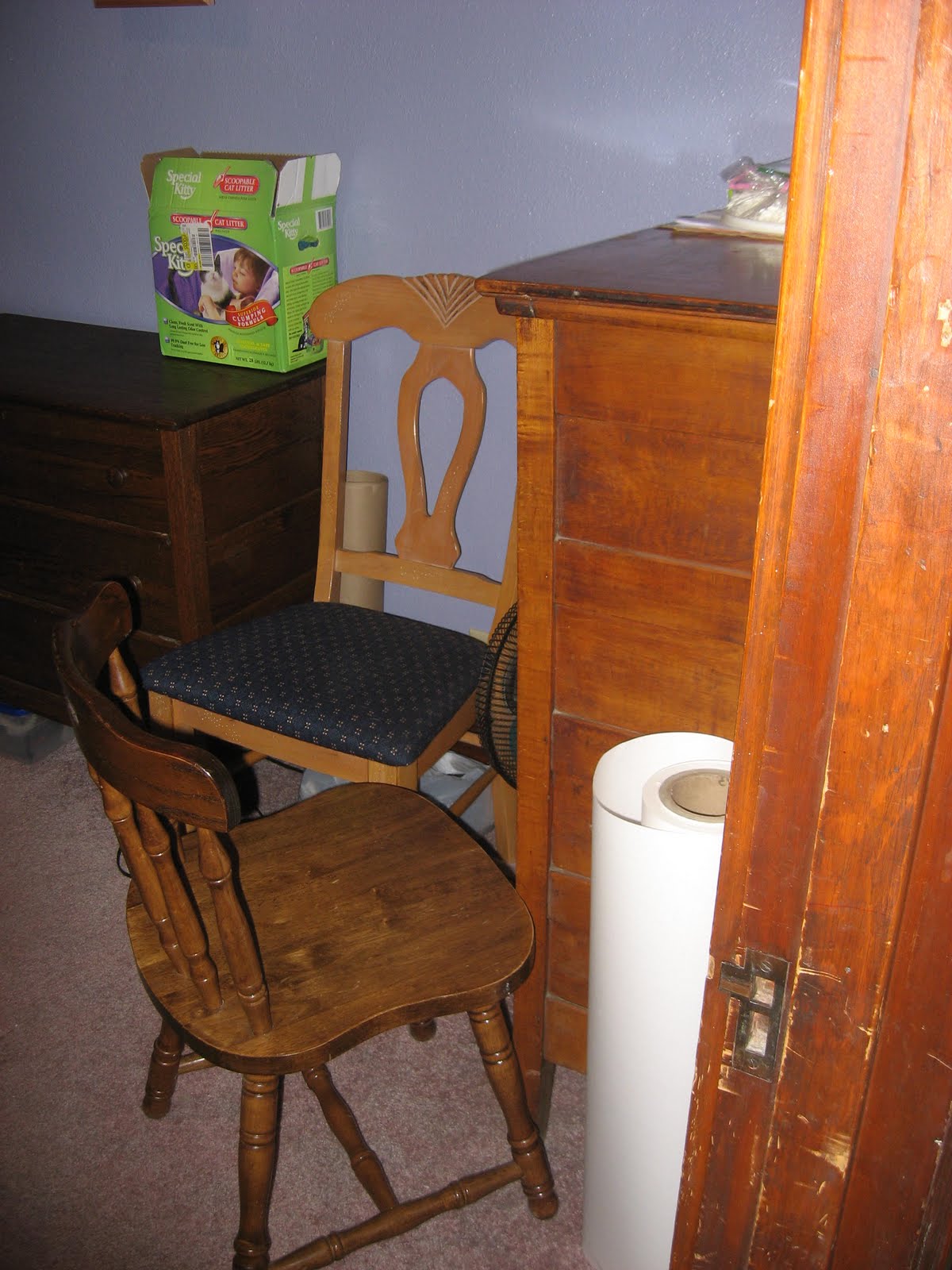 A picture thought I am sharing... While Goose was eating breakfast one morning, I put her Easter bucket full of empty plastic Easter eggs in the spare bedroom. She heard me do it, but didn't see it. After she was out of her highchair, I went downstairs to get dressed. Usually she follows me down, but that day, she didn't.
When I came back upstairs, she was sitting in the dining room (outside of the spare bedroom) playing with her eggs and bucket. The door to the spare room was open, and she'd pushed one of the kitchen chairs (the all wood one in the pic) into the spare bedroom, climbed up, got the bucket, climbed down (thankfully she didn't fall) and got down to business.
I'll admit, I don't know why she didn't pull over the chair that was already in the room, but I'm still marveling at the level of ingenuity displayed. :>)
Giveaway Winners
Congratulations to the winners of my giveaways:
Emily is the winner of the What are all those funny things in food...and should I eat them? CD by Jane Hersey AND the packet of interesting stuff from the Feingold Association of the US.
Joanna is the winner of the second copy of the What are all those funny things in food...and should I eat them? CD by Jane Hersey.
aaaand, the winner of the Frontier Logs from CNS Stores is Heather!
Emily and Joanna, I'll be contacting you for your mailing address, and Heather, I already have yours, so I'll get that forwarded to the appropriate people and hopefully it'll arrive by the time baby #2 does! :>)
Thanks for playing, everybody!
Emily is the winner of the What are all those funny things in food...and should I eat them? CD by Jane Hersey AND the packet of interesting stuff from the Feingold Association of the US.
Joanna is the winner of the second copy of the What are all those funny things in food...and should I eat them? CD by Jane Hersey.
aaaand, the winner of the Frontier Logs from CNS Stores is Heather!
Emily and Joanna, I'll be contacting you for your mailing address, and Heather, I already have yours, so I'll get that forwarded to the appropriate people and hopefully it'll arrive by the time baby #2 does! :>)
Thanks for playing, everybody!
Friday, May 7, 2010
Link Roundup - I Thought It Was Spring Edition
[Edit - sorry, there was a blogger misfire and this published before I was done. Oops.]
It's been cold, windy, with freeze warnings at night. That is not good on the little tomato and pepper plants I put in the garden this weekend. (This year's inaugural garden update is forthcoming.) Ah, well, I'm not ready for the heat of summer yet anyway.
So let's warm up with some links! (or something...)
MAKE
These Quick Craft Pinata Suncatchers from Frugal Family Fun Blog are too cute! (and they're Radar-shaped! We have a miniature donkey on the farm named Radar...)
What a great idea from I am Momma - Hear Me Roar (hee): the Always Tuck Me In Shirt for the wiggly little guys.
Who doesn't love flowers that never die??? Check out this Mother's Day Pool Noodle Bouquet from No Time For Flashcards.
I dig this Milk Jug Curtain from Homemade Mamas. Reusing at its best!
It isn't a tutorial, and it is in French. But I can't stop smiling about this Lonely Cow from les p'tits pieds canadiens. I don't even know what that means. But it's cute!
Craftadoodle has a quiet book including printable patterns! - check it out here.
The crochet hooks might be dug out for this Mini Stuffed Airplane at Inner Child Crochet.
Sun-Kissed Scholars tells us how to Turn Tights Into Knee or Thigh Highs.
Not sure how much of this would make it to Goose to play with - Homemade Edible Play Dough from My Frugal Lifestyle. Sounds yummy! :>)
EAT
I'm still on the search for a good everyday homemade bread recipe that's good for sandwiches; maybe this Bread Machine Sandwich Bread recipe from Frugally Blonde will fit the bill.
DO
This is an old post but lots of great ideas from Trent at The Simple Dollar - a Frugal Rainy Day Box.
Goose isn't old enough to be interested in American Girl stuff yet, but I'm thinking this would be good for a Little House on the Prairie themed party - check out these American Girl Pioneer Party Pics by One Charming Party.
I'm tucking this away for next year (thanks, Sarah!) - Companion Planting by Golden Harvest Organics.
Dabbled tells us how to do a Photo Safari With Kids. What a great idea!
Thanks to Laura at Heavenly Homemakers, I signed up for the Home Depot Gardening Club.
Annemarie pointed out this post on Pest Free Organic Apples. Now if I can just convince my dad, who grows the apples...
Another old post by Trent at The Simple Dollar, but also a good one, A Step-By-Step Guide to Creating a Deal-Finding Homepage and you customize it to exactly what fits your needs.
PRAY & PONDER
Shared on facebook by my city cousin (who grew up on the farm where I first became afraid of cows :>)) was Attention Whole Foods Shoppers, at Foreign Policy.
A good reminder for me - That's Why God Invented Bleach from The H Word.
It's been cold, windy, with freeze warnings at night. That is not good on the little tomato and pepper plants I put in the garden this weekend. (This year's inaugural garden update is forthcoming.) Ah, well, I'm not ready for the heat of summer yet anyway.
So let's warm up with some links! (or something...)
MAKE
These Quick Craft Pinata Suncatchers from Frugal Family Fun Blog are too cute! (and they're Radar-shaped! We have a miniature donkey on the farm named Radar...)
What a great idea from I am Momma - Hear Me Roar (hee): the Always Tuck Me In Shirt for the wiggly little guys.
Who doesn't love flowers that never die??? Check out this Mother's Day Pool Noodle Bouquet from No Time For Flashcards.
I dig this Milk Jug Curtain from Homemade Mamas. Reusing at its best!
It isn't a tutorial, and it is in French. But I can't stop smiling about this Lonely Cow from les p'tits pieds canadiens. I don't even know what that means. But it's cute!
Craftadoodle has a quiet book including printable patterns! - check it out here.
The crochet hooks might be dug out for this Mini Stuffed Airplane at Inner Child Crochet.
Sun-Kissed Scholars tells us how to Turn Tights Into Knee or Thigh Highs.
Not sure how much of this would make it to Goose to play with - Homemade Edible Play Dough from My Frugal Lifestyle. Sounds yummy! :>)
EAT
I'm still on the search for a good everyday homemade bread recipe that's good for sandwiches; maybe this Bread Machine Sandwich Bread recipe from Frugally Blonde will fit the bill.
DO
This is an old post but lots of great ideas from Trent at The Simple Dollar - a Frugal Rainy Day Box.
Goose isn't old enough to be interested in American Girl stuff yet, but I'm thinking this would be good for a Little House on the Prairie themed party - check out these American Girl Pioneer Party Pics by One Charming Party.
I'm tucking this away for next year (thanks, Sarah!) - Companion Planting by Golden Harvest Organics.
Dabbled tells us how to do a Photo Safari With Kids. What a great idea!
Thanks to Laura at Heavenly Homemakers, I signed up for the Home Depot Gardening Club.
Annemarie pointed out this post on Pest Free Organic Apples. Now if I can just convince my dad, who grows the apples...
Another old post by Trent at The Simple Dollar, but also a good one, A Step-By-Step Guide to Creating a Deal-Finding Homepage and you customize it to exactly what fits your needs.
PRAY & PONDER
Shared on facebook by my city cousin (who grew up on the farm where I first became afraid of cows :>)) was Attention Whole Foods Shoppers, at Foreign Policy.
A good reminder for me - That's Why God Invented Bleach from The H Word.
Tuesday, May 4, 2010
Our Nebraska Feedlot and Farm
 When I read that Confined (Concentrated) Animal Feeding Operations was going to be on the Spring Cleaning list, I was quite intrigued. You see, our family farms and raises cattle. In feedlots. Which is considered a CAFO.
The Omnivore's Dilemma has been on my list of things to read since I read The Omnivore’s Delusion, a rebuttal to it. Since this is our livelihood, I embraced the chance to learn more about our operation for this week's carnival. This week's hostess is Kelly the Kitchen Kop tells us about CAFOs and how pastured meats are considered more nutritious at Kitchen Stewardship, and her blog. Katie at Kitchen Stewardship provided a balanced look at Food, Inc. and some other sources at her carnival entry.
I spent quite a bit of time on the phone with Hubs and Hubs's cousin, Chris regarding this topic. (I will be asking them to review this post and I will update any changes they make if I didn't say something correctly. Also all photos are courtesy of my sister-in-law, Rachel, who took them on our farm). Currently we have about 800 head of cattle in our pens, and we own those. We also background for an area feedlot, which means we take cattle when they reach a certain age/size and feed them until they reach another certain age/size. That adds about 400 head of cattle.
We usually get just-weaned calves in September or so and keep them until February. The reason the bigger feedlot uses our feedlot to background is that cattle in our lot gain more weight more quickly and are healthier. I think it's because they get more personal attention. :>)
Crops
In addition to cattle, we also raise crops on about 2,900 acres. This year, we will have 1,500 acres planted to corn, 900 acres planted to soybeans, and 300 acres planted to wheat. We also have some fields planted to alfalfa, and somewhere around 2,000 acres of pasture.
We rotate the crops we plant on each piece of ground. On ground that is irrigated either by a center pivot (picture a big sprinkler) or gravity/flood irrigation (pipe with holes in it that can be opened or closed to let water through to certain rows), we will plant corn one year, then soybeans the next year, and back to corn. On our dryland ground (the only water it receives is rainfall) adds wheat to the rotation after beans. By rotating, we can use less fertilizer and control weeds better.
The resources used to produce corn have decreased dramatically over the past few decades. Better technology means things such as better equipment that means we can get by tilling the ground less. That means less time needed, less fuel burned, and less erosion of the soil, as well as less water needed because the soil is able to better retain the water it already has. Although genetic modification is a hotly debated topic, GM crops mean that we can use less fertilizer and pesticides. Feedlots are also located geographically near corn to reduce transportation costs.
 Feeding Cattle
About half of the corn we raise is fed to our cattle in a specific ratio of corn, ground hay, silage, distillers grains, and pellets that include vitamins, minerals, and a bit of protein. After our harvest is complete, we test the harvested crops to check their nutritional levels and then supplement the animals' diet accordingly using the pellets. The ratio of the corn, hay, silage, and distillers grains depends on the size of the animal and its stage in fattening, and then a certain amount is allotted per head of cattle in the pen.
Silage is made by chopping the entire corn plant - stalk, leaves, cob, and kernels of corn. Distillers grain is a co-product from ethanol production. According to the Iowa Department of Agriculture, "ethanol is produced from the starch in corn and the remaining protein, fiber, vitamins and minerals make up distillers grains."
While the most "natural" diet for cattle is probably grass or hay, animals fed a diet of such take longer to fatten (and thus produce meat). I would like to note that our cattle don't spend all their time in the feedlot. During the winter, they are placed in fields where corn has just been harvested. They glean the corn that was left behind, even digging through snow to find it, and also eat some of the dead leaves and stalks. During the summer, we take them to pastures to graze for as long as the land will support them.
Cattle really *like* corn, though, and there have been many taste test studies that have indicated people prefer beef that is corn fed versus grass fed or oat fed. I can give plenty of anecdotal information as to how cattle prefer corn - one year, another farmer planted corn on his field next to one of our pastures. I lost count of how many times he called to say that our cattle had gotten out and were eating his corn! Thankfully Hubs really worked on fixing that fence and we've received fewer calls since then. According to Chris, people have used grain to finish cattle even back to Biblical times as it improves the taste and texture of the meat.
 Waste Management
The feedlot waste is carefully managed. During the year, we use equipment to push manure away from the feed bunks and the concrete apron on which the cattle stand while eating. Every year, we clean pens by scraping up manure and hauling it to spread on fields to use as fertilizer. There are guidelines as to how much and how often we can apply manure to fields; anyway, too much applied will adversely affect how our crops grow.
There are a couple of "runoff pits" strategically located near our feedlots so that any liquid (such as after a rainfall) will go there. We sometimes pump water from these pits to irrigate nearby fields instead of hauling manure there. Larger feedlots are required to have test wells drilled, so that the groundwater may be monitored for contamination, as we live over the Ogallala Aquifer.
It should be noted that even in pastures, cattle will stand in waste by choice. Standing in water is one of their methods of cooling off, and cattle tend to "do their business" wherever they happen to be standing.
 Antibiotics and Hormones
Healthy animals receive no antibiotics in our feedlot, and Chris estimated that only about 5% of our cattle get sick. Sick animals are kept separate from the rest of the herd. When we receive calves from the feedlot for which we background, we give the calves a bit of antibiotics (typically in their feed) to prevent illness. They have just been weaned and it is a rather high stress time for them.
One of the many things I learned in my conversation with Chris is that far more disease in cattle comes from birds than from the cattle themselves! Also, cattle have immune systems not unlike people, and cold and wet conditions can contribute to cattle becoming sick. Also similarly to people, our cattle receive vaccinations against disease to keep them healthy.
Antibiotics are labeled with a withdrawal period, that ranges from 0 to 30 days. During that period, an animal is not to be slaughtered in order to give the antibiotic time to clear out. Injections are also given under the skin versus in the muscle to prevent the antibiotic from reaching the meat. After slaughter, the carcass is inspected and if an injection site is present, it is visible. The carcass is then taken out of production (I'm not sure what they do with it!) and the processor could punish the producer (us) by anything from not paying for that animal to refusing to buy any further cattle. Therefore, it is extremely important to follow the required guidelines and specifications.
We do give our animals hormone implants to speed their weight gain, and Chris admitted that there are producers that probably overuse hormones. He believes that hormones will eventually be phased out due to selective breeding. We tailor the implants to the animal, conservatively giving them only as much as needed for optimal growth.
E. coli
Something else I did not know is that E. coli is actually a naturally occurring bacteria. According to Chris, we are much more likely to get sick from things such as unwashed contaminated lettuce than meat. Cross contamination is also a problem - for example, reusing the plate which you brought raw burgers to the grill for the cooked burgers without washing it.
Although there probably is a reduction in contamination of grass fed beef, Chris estimated that most cases of E. coli contamination in meat occurs after butchering. Regardless, if meat is handled and cooked properly, your chances of contracting e.Coli from it are very low. Hamburger has the highest chance for contamination because it is made of scraps from many different sources.
Factory Farms
Nebraska actually has safeguards in place to protect family farms and discourage enormous factory farms. Family farms come in many sizes, though. I read Chris some of the statistics quoted by Kelly in her post linked above regarding how much of the meat supply is produced by a very few companies. He feels that end producers of meat likely do this as a means of protecting themselves - that way they know that safeguards are in place, and that precautions are being taken. While I didn't ask Chris this, I also wonder how exactly that breaks down. Perhaps there are a large number of feedlots such as ours that sell to packing plants that sell to the big guys. I don't know how it works, but I suspect it's not quite that neat and tidy.
 What's the Bottom Line?
We (our family) don't believe that we (producers as a whole) would be able to flip the switch and follow all the practices laid out by Food, Inc. and Michael Pollan and others and still produce enough to feed the world.
Besides, I want to point out that not everything on our farm is kept confined. Our chickens have free run of the place, and can be found scratching and pecking around all over. (I've never asked them their motivation for crossing the road, though.) Our miniature donkey, Radar, also gets to roam around, although he occasionally gets a little bit naughty and nips or sneaks up behind you to give you a nudge in the back and that gets him promptly returned to his pen. He isn't lonely there, though... I actually saw him nuzzling, licking, or *something* one of the cows in the pen next to his today. Not sure what they were doing.
Anyway. We don't treat the cattle our family eats any differently than the cattle we produce to sell. Hubs believes that our meat tastes better than what you can buy in the grocery store, and he says he noticed a big difference in taste when he went into the Air Force. We will continue to stay abreast of current research, trends, and technology to provide the best food we can.
PS - Because I don't like knowing what I'm eating looked like when it was staring me in the face, I prefer to think beef shows up in our freezer via the meat fairy. I also think that while Americans as a whole are doing better at learning really where their food comes from, the truth is that farming is a dirty, bloody business (as noted in the Omnivore's Delusion linked above) and it's definitely not as easy as it might seem. You may have heard the phrase "running around like a chicken with its head cut off" - well, there is truth to that statement. And I'm not sure most Americans are ready to deal with that sort of reality regarding their food...
Saturday, May 1, 2010
Link Roundup - First Anniversary Edition
It feels kinda funny to have a whole year of blogging under my belt. I still feel like such a newbie at it (and I admit I don't spend a lot of time learning how to better my blogging) and I'm still having fun. It seems that Reading the Whole Internet has been my most consistent post - I sure enjoy putting it together and I hope you guys enjoy checking out some of what the interwebs have to offer from one convenient location.
Enough of the sappy stuff - let's check out some links!
I don't usually do this, but there is one post that I want to make sure you see. Under the Table and Dreaming has a neat tutorial on Freeze Pop Holders that is SUPER EASY and also quite cute. The very best part of all, though, is the link back to her post on Healthy Summertime DIY Freeze Pops! NO additives, no junk, just whatever you want to put in. LOVE IT!
MAKE
How pretty, and how reusable! Make and Takes has a tutorial on making a Handmade Paper Corsage just in time for Mother's Day.
This Birthday Cake Puzzle Inspired By Mrs. Rosey Posey sounds like a lot of fun! Way to go, ImpressYourKids!
I am really digging this Crazy Easy Wall Art from Frugal Home Ideas. I love how people can take an ordinary item and use it in a funky way, and end up doing something cool like this!
Dying of cuteness here, this Napkin Dress Tutorial - Perfect For a Shower at How Does She? is SO SWEET.
Oops, I had briefly thought about making these May Baskets with Goose... guess I'll tuck that idea away for next year. (@ The Cupcake Cuppy)
This is actually just barely a "MAKE" versus a "DO" - Repurposed Onesies and T-Shirts = My Favorite No Sew Bib from The Mother Huddle.
Thus continues my fascination with felt food - Homemade by Jill has a great Felt Food Roundup.
Admittedly the only slide at our park is waaaay too tall and scary yet for Goose, but I'm tucking away the idea for this Towel Slide Sled from Pony Tails & Fish Scales. Very well done indeed!
These next three links come courtesy of Zimms Zoo - an almost-no-sew Diaper Clutch/Changing Station from Just Another Day In the Lives Of..., a Reusable Snack Bag Tutorial from Laura Wilson, and a Kitchen On The Go Tutorial for another reusable snack bag from Create Studio.
EAT
This post on Tipnut on Freezing Strawberries had me searching for a pick-your-own place, which made me think of Sarah's Honey Sweetened Strawberry Preserves. MMM!
I made A Year of Slow Cooking's Slow Cooker Peanut Butter Cup Cake for my birthday, and it was pretty good. I have a hot fudge (read: all chocolate!) version that I think I prefer, though this was interestingly better the next day than it was the first.
We weren't exactly crazy about the apple version I tried quite a while back, but I'm going to give the peach version of Puff Pancake a try. And I'll try not to be jealous of Annemarie's big family that necessitates doubling of the recipe. :>)
Katie at Kitchen Stewardship tells us How To Make Crispy Nuts to Reduce Phytic Acid.
I'm not sure if I've ever actually eaten them, but I'm fascinated by turnips. Tipnut tells us how to cook them here.
Speaking of MMM, Donna at Mom's Frugal tells us how to make Homemade Buttermilk Buns.
It's interesting that Tammy's Recipes just posted Whole Wheat Pita Chips... I just make whole wheat pitas this week.
DO
Here's something I really need to do - learn how to Exercise When It's Not About Vanity. Heaven knows I'm the queen of excuses. (@ Conversion Diary)
Or maybe I could go all-out and jump into this Marine Style Fitness program. Although something tells me that would kill me. I'm afraid to even complete the free registration to see what it entails! So if you do it, let me know, k?
In case I haven't convinced you yet, here is another post on Extended Rear Facing for kiddos in car seats from Breezy Mama.
More Style Than Cash gives us some great tips on Photographing Children's Portraits.
When fall potato harvest hits, I am going to be ALL OVER Laura at Heavenly Homemaker's suggestion to Make Your Own Frozen Hashbrowns. Vacuum sealer, here we come! (Though I'll admit, I will likely make them into cubes instead of shredding them...for some reason, my brain thinks they taste better that way.)
Peppertowne gives us an easy How To... Drop-Down Menu tutorial.
Interesting reading - Outspoken Media explains The 5 Old Blogging Rules Killing Your Readership.
PRAY & PONDER
Oh, how I need to be reminded often of these words: "Eternity is a whole lot longer than a handful of decades on earth. Prioritize accordingly." Read the rest at Conversion Diary.
This post struck a chord with me - Of Weeds and Sin at Pondered in My Heart. It will certainly give food for thought as I undertake my own weeding projects.
This interesting article on The Shroud of Turin at The Catholic Thing noted a finding that I hadn't yet heard about - Christ's death certificate. Wow.
I really enjoyed this article from the National Review Online called Nun Sense: Women in the Catholic Church. I didn't realize there was a difference between a nun and a sister, for one!
RANDOM
With a nod and a squeeze to my cousin Lisa, I'm still cracking up over this post at Hyperbole and a Half The Alot Is Better Than You At Everything. (Hint: it's a hilarious look at the incorrect usage of "alot" instead of "a lot". There's a fictional monster involved that is actually quite adorable.)
Happy clicking!
Enough of the sappy stuff - let's check out some links!
I don't usually do this, but there is one post that I want to make sure you see. Under the Table and Dreaming has a neat tutorial on Freeze Pop Holders that is SUPER EASY and also quite cute. The very best part of all, though, is the link back to her post on Healthy Summertime DIY Freeze Pops! NO additives, no junk, just whatever you want to put in. LOVE IT!
MAKE
How pretty, and how reusable! Make and Takes has a tutorial on making a Handmade Paper Corsage just in time for Mother's Day.
This Birthday Cake Puzzle Inspired By Mrs. Rosey Posey sounds like a lot of fun! Way to go, ImpressYourKids!
I am really digging this Crazy Easy Wall Art from Frugal Home Ideas. I love how people can take an ordinary item and use it in a funky way, and end up doing something cool like this!
Dying of cuteness here, this Napkin Dress Tutorial - Perfect For a Shower at How Does She? is SO SWEET.
Oops, I had briefly thought about making these May Baskets with Goose... guess I'll tuck that idea away for next year. (@ The Cupcake Cuppy)
This is actually just barely a "MAKE" versus a "DO" - Repurposed Onesies and T-Shirts = My Favorite No Sew Bib from The Mother Huddle.
Thus continues my fascination with felt food - Homemade by Jill has a great Felt Food Roundup.
Admittedly the only slide at our park is waaaay too tall and scary yet for Goose, but I'm tucking away the idea for this Towel Slide Sled from Pony Tails & Fish Scales. Very well done indeed!
These next three links come courtesy of Zimms Zoo - an almost-no-sew Diaper Clutch/Changing Station from Just Another Day In the Lives Of..., a Reusable Snack Bag Tutorial from Laura Wilson, and a Kitchen On The Go Tutorial for another reusable snack bag from Create Studio.
EAT
This post on Tipnut on Freezing Strawberries had me searching for a pick-your-own place, which made me think of Sarah's Honey Sweetened Strawberry Preserves. MMM!
I made A Year of Slow Cooking's Slow Cooker Peanut Butter Cup Cake for my birthday, and it was pretty good. I have a hot fudge (read: all chocolate!) version that I think I prefer, though this was interestingly better the next day than it was the first.
We weren't exactly crazy about the apple version I tried quite a while back, but I'm going to give the peach version of Puff Pancake a try. And I'll try not to be jealous of Annemarie's big family that necessitates doubling of the recipe. :>)
Katie at Kitchen Stewardship tells us How To Make Crispy Nuts to Reduce Phytic Acid.
I'm not sure if I've ever actually eaten them, but I'm fascinated by turnips. Tipnut tells us how to cook them here.
Speaking of MMM, Donna at Mom's Frugal tells us how to make Homemade Buttermilk Buns.
It's interesting that Tammy's Recipes just posted Whole Wheat Pita Chips... I just make whole wheat pitas this week.
DO
Here's something I really need to do - learn how to Exercise When It's Not About Vanity. Heaven knows I'm the queen of excuses. (@ Conversion Diary)
Or maybe I could go all-out and jump into this Marine Style Fitness program. Although something tells me that would kill me. I'm afraid to even complete the free registration to see what it entails! So if you do it, let me know, k?
In case I haven't convinced you yet, here is another post on Extended Rear Facing for kiddos in car seats from Breezy Mama.
More Style Than Cash gives us some great tips on Photographing Children's Portraits.
When fall potato harvest hits, I am going to be ALL OVER Laura at Heavenly Homemaker's suggestion to Make Your Own Frozen Hashbrowns. Vacuum sealer, here we come! (Though I'll admit, I will likely make them into cubes instead of shredding them...for some reason, my brain thinks they taste better that way.)
Peppertowne gives us an easy How To... Drop-Down Menu tutorial.
Interesting reading - Outspoken Media explains The 5 Old Blogging Rules Killing Your Readership.
PRAY & PONDER
Oh, how I need to be reminded often of these words: "Eternity is a whole lot longer than a handful of decades on earth. Prioritize accordingly." Read the rest at Conversion Diary.
This post struck a chord with me - Of Weeds and Sin at Pondered in My Heart. It will certainly give food for thought as I undertake my own weeding projects.
This interesting article on The Shroud of Turin at The Catholic Thing noted a finding that I hadn't yet heard about - Christ's death certificate. Wow.
I really enjoyed this article from the National Review Online called Nun Sense: Women in the Catholic Church. I didn't realize there was a difference between a nun and a sister, for one!
RANDOM
With a nod and a squeeze to my cousin Lisa, I'm still cracking up over this post at Hyperbole and a Half The Alot Is Better Than You At Everything. (Hint: it's a hilarious look at the incorrect usage of "alot" instead of "a lot". There's a fictional monster involved that is actually quite adorable.)
Happy clicking!
Happy Blogiversary to Me! Giveaway Time!

EDIT - Giveaway is now closed. Congratulations to Heather!
Through the kindness of the people at CSN Stores, I'm having my very first sponsored giveaway! They have many, many different sites will all kinds of neat stuff available. I had the choice of doing a review, where *I'd* get to keep the thing, and a giveaway, where YOU get something. I'm all about my readers, though, so I chose the giveaway.
It was tough to narrow down what to do - they have everything from kids beds to outdoor toys and everything in between. Thankfully, they gave me a price limit to keep me in check! I did a little bit of wiggling, though, and chose Tinker Toy 114 Piece Frontier Logs and Tinker Toy 75 Piece Frontier Logs. Both will go to one lucky winner. (Believe me, I spent a LOT of time looking at their Melissa and Doug Arts and Crafts section...)
So, it seems I was too busy recovering from writing my two enormous posts on food additives to properly celebrate my one year blog anniversary. Take a quick walk down memory lane with me -
My very first post - Welcome to Nettacow! The only things that have really changed are that Goose is now potty-trained (can you believe I MISS the cloth diapers?!?) and she's also weaned. :>)
Have you ever wondered Why Nettacow? Check that post out to hear the story.
I was almost afraid to look for this next post - my Inaugural Garden Update. My hard-working, corn-planting Hubs hasn't even had time to till our garden yet. That's OK, I think we're still ahead of the game with regards to frost. Our lows have been in the low 40s, which isn't exactly plant growing weather.
So, if you'd like to win this super fun giveaway, here's how:
1) Leave a comment on this post. Make sure I have a way to contact you if you win! You can leave a cryptic myemail at domain dot com if you prefer.
2) Subscribe to my blog in a reader or by e-mail, or "follow" me. Make sure you leave a comment that you do! [And if you want to enter the giveaway for the What are all those funny things in food...and should I eat them? by Jane Hersey from the Feingold Association of the US, please make sure to leave me a comment over there that you subscribe or follow. Depending on how you sign up, I don't know who you are! Not that I *need* to know in any creepy way, of course...just if you want to sign up for the giveaway. Moving on...]
3, 4, 5) Share this giveaway in a blog post, on facebook, or on twitter. Please leave a separate comment for each that you do.
This giveaway will end next Sunday, the 9th, at 9 PM central time. I'll use random.org to pick a winner. Remember, you don't have to have kids of your own to enter - you can give it to nieces or nephews, grandkids, next-door-neighbors, a lovely family at your church, donate it at Christmastime - it's up to you! Good luck!
[Disclaimer - CSN Stores is providing the items for this giveaway free of charge. I was not compensated in any way for this giveaway. If there's any other legal mumbo jumbo that I ought to include, please consider it inserted here. Thank you.]
Tuesday, April 27, 2010
First Attempt at Soaking Oats
Yesterday, I bought a quart of plain yogurt and used it to make whey, which I then used last night to make a double batch of soaked oats. This morning, I put about half of the oats on a cookie sheet to dehydrate as recommended and used the other half to make baked oatmeal. I adjusted my recipe by omitting the milk and applesauce, and only using two tablespoons of butter. I also cut the brown sugar down to half a cup.
The results on the soaked baked oatmeal? So-so. I actually thought it tasted sort of "raw" even though I baked it for the normal time. I'm thinking that using the dehydrated oats will make a big difference.
 KITCHEN TIP:
I used my food processor to break up the clumps of dehydrated oats, and instead of trying to dump them out of the open "jar" (is that the right word?) of the processor, I left the lid on, removing the push-cap-thingie (where *am* I getting all these technical terms today??) and dumping the contents out the spout.
With my food processor, I have to loosen the lid (don't have to remove it entirely) in order to loosen the "jar". After loosening the bottom piece, I tighten the lid back on and remove it from the base. This has helped me avoid a number of spills!
And, to save on dishes, I made three different recipes of the power bar (Larabar knockoffs) from Katie at Kitchen Stewardship's Healthy Snacks to Go eBook. I seriously can't get enough of those things!! I was privileged to help edit it, and oh my stars, I am really enjoying the "fruits" of that labor. I'll be reviewing it soon.
For more kitchen tips, visit Tammy's Recipes.
Please check out my post for the Spring Cleaning Carnival Getting the Food Additives Out! You can link up your posts that have anything to do with food additives (see my post for different suggestions) and I am also giving away two copies of a CD by Jane Hersey of the Feingold Association of the United States called "What are all those funny things in food...and should I eat them?"
The results on the soaked baked oatmeal? So-so. I actually thought it tasted sort of "raw" even though I baked it for the normal time. I'm thinking that using the dehydrated oats will make a big difference.
 KITCHEN TIP:
I used my food processor to break up the clumps of dehydrated oats, and instead of trying to dump them out of the open "jar" (is that the right word?) of the processor, I left the lid on, removing the push-cap-thingie (where *am* I getting all these technical terms today??) and dumping the contents out the spout.
With my food processor, I have to loosen the lid (don't have to remove it entirely) in order to loosen the "jar". After loosening the bottom piece, I tighten the lid back on and remove it from the base. This has helped me avoid a number of spills!
And, to save on dishes, I made three different recipes of the power bar (Larabar knockoffs) from Katie at Kitchen Stewardship's Healthy Snacks to Go eBook. I seriously can't get enough of those things!! I was privileged to help edit it, and oh my stars, I am really enjoying the "fruits" of that labor. I'll be reviewing it soon.
For more kitchen tips, visit Tammy's Recipes.
Please check out my post for the Spring Cleaning Carnival Getting the Food Additives Out! You can link up your posts that have anything to do with food additives (see my post for different suggestions) and I am also giving away two copies of a CD by Jane Hersey of the Feingold Association of the United States called "What are all those funny things in food...and should I eat them?"
Monday, April 26, 2010
Spring Cleaning Carnival - Get the Food Additives OUT!
Now What Do I Do?
Head over to Kitchen Stewardship to read My Story: How I Became Concerned With What We Ate, and What's the Big Deal regarding food additives. Your head may be reeling like mine with all this information, and you may be left thinking "so what DO I eat?"
Katie said it best when she said "There’s a lot of controversy out there about what is healthy and what is not." She further tells us to "Do your best. Pray that God takes your best effort and makes it whole, that He provides good health for your family both because of AND in spite of what you may end up doing in the kitchen."
Every person is different. Every family is different. Every situation is different. Although she was referring to parenting, mother of eight Danielle Bean has said simply "do what works best for your family." YOU know your family best. Further, in the case of food additives, similar to sugar and gluten and many other things, there are many different levels of sensitivities. What may make one person violently ill may have no effect at all on another.
Finally, I'm a big proponent of Everything In Moderation. This, friends, is why you'll pry bacon out of my cold, dead hands! Lack of availability in my rural location coupled with high prices in general mean that nitrate-free bacon is out of my budget. I eat regular bacon occasionally and in small amounts, and I enjoy it very much.
These posts on MSG have some steps that are can be applied to avoiding all these additives, and you can prioritize your homemade foods using this basic changes post.
Possible baby steps are:
* check labels - just become more aware.
* replace one food item each week with an additive-free item.
* replace processed snack foods with whole foods (like a piece of fruit or some vegetables, etc.), or check out Katie's new eBook Healthy Snacks to Go. (I can assure you that the larabar knockoffs are DELICIOUS. Our first batch lasted only a couple of hours, so the next one we try will be a double batch right out of the gate!)
* eat out less.
* Katie recommends if we choose one thing, that we work on our omega 3 vs. 6 balance.
To Make Strides, try:
* make more of your food from scratch, and make homemade when it counts by prioritizing your "from scratch" items based on what your family eats the most of so your hard work makes the most impact. Ratchet up the flavor of your homemade items with herbs, lemon or lime juice, and other healthy choices.
* plan ahead: meal planning is a must!
* you've heard about "shopping the perimeter" of your grocery store - stick to meats, produce (fresh or frozen), dairy, etc. that is typically found around the edges of most grocery stores. An exception to this would be the baking aisle, I suppose, and your store might be like my sister-in-law's where the frozen foods are in the middle. :>)
Ready for a Leap of Faith?
Really, it's up to you as to how much or little you do. You can try to avoid all food additives if you're willing to invest the time and money to make things from scratch, not to mention the careful shopping for ingredients. If you or a member of your family might be sensitive to additives, it may very well be worth it to try.
Also, now that you're armed with this abundance of information, try just observing what effects you experience after eating certain foods. Perhaps you notice that even though caffeine withdrawal gives you a headache, you still get a headache after drinking a soda pop with high fructose corn syrup and artificial colors. Maybe your little one is more prone to meltdowns a couple of hours after eating rainbow colored fish crackers. If you're absent-minded like me, try to take a few minutes at the end of the day to jot down any additive-laden foods that were consumed and any ill-effects you may have observed. You might be surprised!
In closing, these are important additives to avoid, but really any weird ingredient that you can't pronounce makes a "food" into a "product". Best practice is to make everything from scratch, but for normal, realistic people that just can't happen. The baby steps and making strides are ways to (a) choose the safer processed foods when you just need something fast and (b) prioritize your homemade items in general.
But Wait! There's More!
EDIT - Giveaway is now closed. Congratulations to Emily and Joanna!
We are also having a giveaway in conjunction with getting the food additives out! The Feingold Association of the US has generously donated their CD What are all those funny things in food...and should I eat them?" by Jane Hersey. They generously sent an extra copy for my research regarding this topic, and I'm going to give that one away, too! Furthermore, I'm going to share the additional information that FAUS sent, including back issues of their newsletter Pure Facts. Lots of great info if you're just getting started on this journey! You can enter the giveaway by:
* linking up your post here (see below),
* commenting here on your experience with food additives,
* subscribe to my blog via following, a reader, or use the box at the top left to get posts via e-mail, leave another comment to let me know,
* share this post via social media (twitter, facebook, blog, etc.) and leave another comment to let me know.
That's up to four entries! Make sure I have a way to contact you if you win, either via your blogger profile, your blog, an e-mail address (you can leave it in the cryptic form youremail at domain dot com if you prefer). The giveaway will end Tuesday, May 3 at 10PM central time. Please have a US or Canadian mailing address.
Next week's hostess is Kelly the Kitchen Kop who will be covering CAFOs, which are "concentrated animal feeding operations" or "confined animal feeding operations". I'm actually hoping to have my Hubs weigh in on this topic, as a big part of our farming operation is our cattle feedlots. You can see all the carnival topics past and present here.
Share Your Wealth of Knowledge
Now it's your turn. I have covered a TON of ground here, and there is lots more left plus, as I said, each of these topics could turn into a post on their own. So, what do you have to say about food additives? You can link up research or information on any food additive, personal story of avoidance, ramblings about processed food. ANY RECIPE that helps you avoid packaged food with additives by making your own. Please link up your posts below. Thanks for joining us! (If you subscribe in a reader or via e-mail, click through to enter posts in the linky and/or leave a comment.)
PS - I have managed to mostly give up my one-root-beer-a-day habit with a baby step switch to ginger ale. Anybody have any good suggestions for a soda pop substitute? We're experimenting with a can of juice concentrate plus a liter of club soda with some good results, but this is not exactly frugal and pretty high in sugar. I'd love some suggestions! [and I'll freely admit that water kefir is probably a bit over my head for now...] Thanks!
Head over to Kitchen Stewardship to read My Story: How I Became Concerned With What We Ate, and What's the Big Deal regarding food additives. Your head may be reeling like mine with all this information, and you may be left thinking "so what DO I eat?"
Katie said it best when she said "There’s a lot of controversy out there about what is healthy and what is not." She further tells us to "Do your best. Pray that God takes your best effort and makes it whole, that He provides good health for your family both because of AND in spite of what you may end up doing in the kitchen."
Every person is different. Every family is different. Every situation is different. Although she was referring to parenting, mother of eight Danielle Bean has said simply "do what works best for your family." YOU know your family best. Further, in the case of food additives, similar to sugar and gluten and many other things, there are many different levels of sensitivities. What may make one person violently ill may have no effect at all on another.
Finally, I'm a big proponent of Everything In Moderation. This, friends, is why you'll pry bacon out of my cold, dead hands! Lack of availability in my rural location coupled with high prices in general mean that nitrate-free bacon is out of my budget. I eat regular bacon occasionally and in small amounts, and I enjoy it very much.
These posts on MSG have some steps that are can be applied to avoiding all these additives, and you can prioritize your homemade foods using this basic changes post.
Possible baby steps are:
* check labels - just become more aware.
* replace one food item each week with an additive-free item.
* replace processed snack foods with whole foods (like a piece of fruit or some vegetables, etc.), or check out Katie's new eBook Healthy Snacks to Go. (I can assure you that the larabar knockoffs are DELICIOUS. Our first batch lasted only a couple of hours, so the next one we try will be a double batch right out of the gate!)
* eat out less.
* Katie recommends if we choose one thing, that we work on our omega 3 vs. 6 balance.
To Make Strides, try:
* make more of your food from scratch, and make homemade when it counts by prioritizing your "from scratch" items based on what your family eats the most of so your hard work makes the most impact. Ratchet up the flavor of your homemade items with herbs, lemon or lime juice, and other healthy choices.
* plan ahead: meal planning is a must!
* you've heard about "shopping the perimeter" of your grocery store - stick to meats, produce (fresh or frozen), dairy, etc. that is typically found around the edges of most grocery stores. An exception to this would be the baking aisle, I suppose, and your store might be like my sister-in-law's where the frozen foods are in the middle. :>)
Ready for a Leap of Faith?
Really, it's up to you as to how much or little you do. You can try to avoid all food additives if you're willing to invest the time and money to make things from scratch, not to mention the careful shopping for ingredients. If you or a member of your family might be sensitive to additives, it may very well be worth it to try.
Also, now that you're armed with this abundance of information, try just observing what effects you experience after eating certain foods. Perhaps you notice that even though caffeine withdrawal gives you a headache, you still get a headache after drinking a soda pop with high fructose corn syrup and artificial colors. Maybe your little one is more prone to meltdowns a couple of hours after eating rainbow colored fish crackers. If you're absent-minded like me, try to take a few minutes at the end of the day to jot down any additive-laden foods that were consumed and any ill-effects you may have observed. You might be surprised!
In closing, these are important additives to avoid, but really any weird ingredient that you can't pronounce makes a "food" into a "product". Best practice is to make everything from scratch, but for normal, realistic people that just can't happen. The baby steps and making strides are ways to (a) choose the safer processed foods when you just need something fast and (b) prioritize your homemade items in general.
But Wait! There's More!
EDIT - Giveaway is now closed. Congratulations to Emily and Joanna!
We are also having a giveaway in conjunction with getting the food additives out! The Feingold Association of the US has generously donated their CD What are all those funny things in food...and should I eat them?" by Jane Hersey. They generously sent an extra copy for my research regarding this topic, and I'm going to give that one away, too! Furthermore, I'm going to share the additional information that FAUS sent, including back issues of their newsletter Pure Facts. Lots of great info if you're just getting started on this journey! You can enter the giveaway by:
* linking up your post here (see below),
* commenting here on your experience with food additives,
* subscribe to my blog via following, a reader, or use the box at the top left to get posts via e-mail, leave another comment to let me know,
* share this post via social media (twitter, facebook, blog, etc.) and leave another comment to let me know.
That's up to four entries! Make sure I have a way to contact you if you win, either via your blogger profile, your blog, an e-mail address (you can leave it in the cryptic form youremail at domain dot com if you prefer). The giveaway will end Tuesday, May 3 at 10PM central time. Please have a US or Canadian mailing address.
Next week's hostess is Kelly the Kitchen Kop who will be covering CAFOs, which are "concentrated animal feeding operations" or "confined animal feeding operations". I'm actually hoping to have my Hubs weigh in on this topic, as a big part of our farming operation is our cattle feedlots. You can see all the carnival topics past and present here.
Share Your Wealth of Knowledge
Now it's your turn. I have covered a TON of ground here, and there is lots more left plus, as I said, each of these topics could turn into a post on their own. So, what do you have to say about food additives? You can link up research or information on any food additive, personal story of avoidance, ramblings about processed food. ANY RECIPE that helps you avoid packaged food with additives by making your own. Please link up your posts below. Thanks for joining us! (If you subscribe in a reader or via e-mail, click through to enter posts in the linky and/or leave a comment.)
PS - I have managed to mostly give up my one-root-beer-a-day habit with a baby step switch to ginger ale. Anybody have any good suggestions for a soda pop substitute? We're experimenting with a can of juice concentrate plus a liter of club soda with some good results, but this is not exactly frugal and pretty high in sugar. I'd love some suggestions! [and I'll freely admit that water kefir is probably a bit over my head for now...] Thanks!
Subscribe to:
Posts (Atom)


 Posts
Posts